How to plan a live swag day at HQ (four-week timeline)
A swag day — a station in the lobby or commons where any employee can press gear during work hours — is the lowest-stakes way to bring on-demand printing in-house. No party to plan, no venue contract. Here's the four-week runway we hand clients, week by week.
Week 1: scope and greenlight
- Pick the date and a 4–6 hour service window. Tuesday–Thursday, spanning lunch, gets the best turnout by a wide margin.
- Estimate participants — for HQ days, assume 60–80% of on-site headcount will press something if the window covers lunch.
- Get the number approved: the cost answer gives you the anchors so procurement isn't guessing.
Week 2: art and product
- Choose 3–8 designs. The menu that works: one hero logo treatment, one or two department marks, one "fun" piece the brand team blesses, one legacy throwback if you have history worth wearing.
- Pick garments — a standard tee (Bella+Canvas 3001 is our default), one premium layer, and optionally a cap-and-patch pairing.
- Send files; we return press-ready proofs within days. Brand sign-off here means zero art surprises on the floor.
Week 3: logistics and comms
- Confirm placement with facilities: 10×10 ft, two standard circuits, near natural foot traffic. Forward them the setup requirements — it answers their questions verbatim.
- Announce twice: a save-the-date early in the week, a menu preview the day before. Showing the actual designs beforehand doubles early-window turnout.
- Decide the remote-employee story now — a follow-up cohort date beats mailing consolation items later.
Week 4: run the day
- Crew loads in 60–90 minutes before the window opens; the station is pressing test pieces before the first email reminder lands.
- Expect two waves: lunch, then 3–4 pm. The lull between is when executives wander down — quietly the best photos of the day.
- Close with a count: pieces produced, by design and size. That report is your case for making it quarterly.
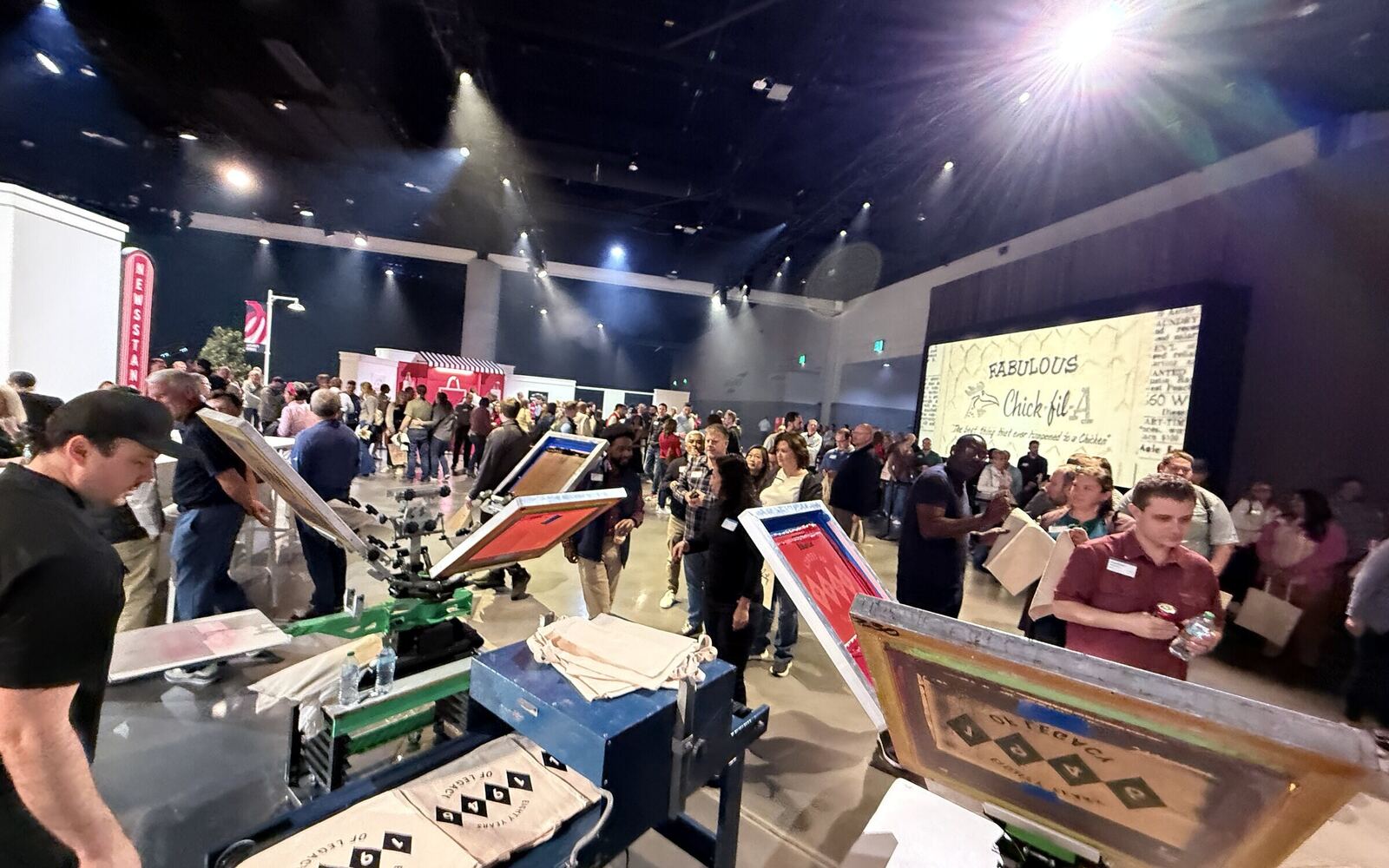
Placement: the difference between a line and a shrug
Where the station sits decides half the turnout. The winning spots share one property: people pass them without meaning to. Main lobby beats the nice-but-remote event space every time; adjacent-to-the-café beats both. Keep the press side against a wall so the working noise (a rhythmic hiss, about as loud as an espresso machine) points away from the nearest desks, leave a clear six feet for the browse-and-order line, and resist the urge to hide it on a different floor "so it doesn't disturb anyone." A swag day nobody stumbles into is a swag day that under-delivers, and the whole point of pressing live is that watching it is the advertisement.
Ordering blanks when you can't know the sizes
Here's the quiet superpower of the format: you don't forecast sizes, because nobody's size is decided until they're standing at the wall. We stock the size curve from national distribution data, weight it slightly by what we know about the crowd, and bring a 10 percent buffer on top of the participation estimate. Whatever goes unpressed returns with us — your invoice reflects pieces produced, not pieces staged. The one input that genuinely helps: an honest on-site headcount for the day, not the org-chart number. Badge data from a comparable Tuesday is worth more than any RSVP form.
The remote-team question, answered before someone asks it
Every HQ swag day surfaces the same Slack message by 2 pm: "what about those of us who aren't in the office?" Have the answer ready in the announcement, not improvised at the station. The options that work, in descending order of goodwill: a second cohort date timed to an all-hands week when remote staff fly in; a small held-back allocation pressed to order during the day and shipped that week; or an honest "this one's an on-site perk" paired with something else for the distributed team. What doesn't work is silence — the photos will reach every remote channel within the hour, and the policy should arrive with them.
Turning a good swag day into a program
The end-of-day production report — pieces by design, garment, and hour — is the seed of a quarterly rhythm. Keep the hero logo design evergreen, rotate one seasonal or campaign piece per quarter, and let the report tell you which designs earned their slot. Teams that run it quarterly see the second event outdraw the first, because the shirts from round one spent three months walking the halls as advertising. Most first-timers over-plan the merch and under-plan the announcement — the station sells itself once one person walks back to their desk in a fresh shirt. If a swag day goes well, the same kit scales to onboarding cohorts and appreciation events without re-learning anything.