On-demand swag printing vs. bulk ordering: the real math
Both models put logos on garments. They differ on one axis that changes everything downstream: when the printing decision gets made. Bulk decides months early with a forecast; on-demand decides at the moment a person points at a design. Here's how to pick.
The metric that settles arguments: cost per kept item
Invoice totals mislead because they price production, not outcomes. Divide total spend by items that ended up with a person who wanted them and the models separate fast. A $8,000 bulk order that yields 350 claimed pieces costs ~$22.86 per kept item. A $6,500 live station that presses 380 requested pieces costs ~$17.10 — and every one of those was made in the recipient's actual size.
| Bulk order | On-demand station | |
|---|---|---|
| Sizing | Forecast curve, guessed early | Chosen live by each person |
| Leftovers | Built into the safety margin | Structurally zero |
| Design risk | One committee pick for everyone | Menu of 3–8; guests self-sort |
| Experience value | None — it's fulfillment | The station is programming |
| Best at | Uniformity & huge volume | Events, choice, exact counts |
When bulk genuinely wins
- Uniforms and dress codes: identical gear, known roster, replenished on a schedule.
- Shipping-based programs: mailed gifts to remote staff — no event, no station.
- Massive single-SKU volume: thousands of identical pieces where per-unit price is the only variable that matters.
When on-demand wins
- Any gathering with unpredictable turnout: parties, conferences, onboarding cohorts, booth traffic.
- Date- or logo-volatile moments: rebrands in progress, event-dated designs, campaign-specific art that expires.
- When you need the moment, not just the merch: the press line is entertainment that also happens to produce the takeaway.
The hybrid most teams actually run
Bulk for the operational layer (uniforms, new-hire mailers to remote employees), live stations for the human layer (the party, the kickoff, the show booth). Budgets stay predictable, and neither model gets stretched into jobs it's bad at. If you're weighing a specific event, the cost answer has the current anchors and the format pages show how stations flex by occasion.
The three bulk costs that never make the invoice
Cost per kept item only counts what you can see. Three more line items hide off the books. Storage: the surplus doesn't vanish — it occupies a closet, then a storage unit, then a facilities email thread nobody wants to own. Size-exchange labor: somebody on your team becomes the swag librarian, fielding "do we have this in a large" messages for six months; at loaded salary rates that quiet role costs more than most printing. Disposal: when the logo changes or the year rolls over, the remainder gets donated at best and dumpstered at worst — the failure mode covered in our leftover swag answer. None of these appear on the bulk quote, which is precisely why the bulk quote looks so good.
What the on-demand line item is actually buying
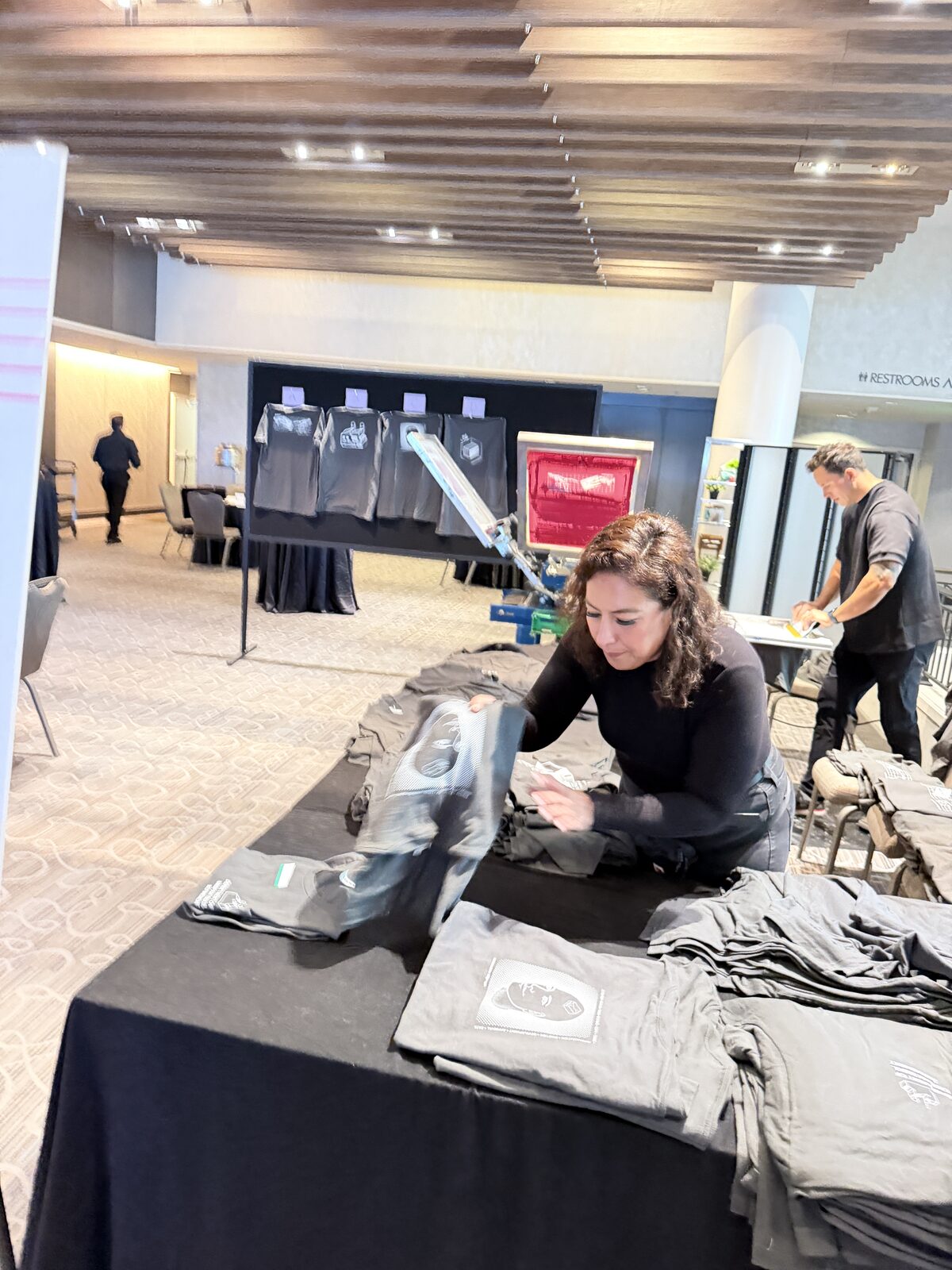
The station quote bundles four things: the press hardware and garment wall, a crew billed at $250 an hour from load-in through strike, blanks consumed at the exact rate people claim them, and the operational slack to absorb a turnout miss in either direction. A local staffed station starts around $5,000, and the number that scales is almost entirely hours and headcount. When turnout runs 20 percent over forecast, the crew presses more blanks from buffer stock; when it runs under, the unpressed blanks return with us instead of aging in your closet. That asymmetry — misses cost you nothing either way — is the structural advantage no bulk discount can price against.
The rebrand insurance nobody prices in
One scenario deserves its own paragraph because it recurs so often: the company mid-rebrand, or about to be. Bulk inventory ordered under the old mark becomes instant landfill-in-waiting the day the new logo ships — we've seen entire pallets stranded by a typography refresh. On-demand carries zero of that exposure. Art files swap the morning of the event if they have to, and the only thing printed under any logo is what someone claims while it's current. If your brand team has a refresh anywhere on the roadmap, that fact alone usually decides the model.
Run your own numbers before the meeting
The five-minute homework that settles the internal debate: pull last year's swag invoice, count what's still in the closet, and compute your real cost per kept item. Then price the same headcount as a live station via the cost anchors. Most teams discover the "cheap" bulk order was carrying a 30-to-40-percent waste rate — and that the station, which doubles as the event's entertainment, was never actually the expensive option. Bring both numbers to the budget meeting and let the spreadsheet argue for you.